Fotowalk Vienna: Exploring the 6th District (Mariahilf)
Introduction
The first day of my photography challenge took me to Vienna’s 6th district, Mariahilf. Armed with the PC‑E NIKKOR 24mm f/3.5D ED — a fully manual tilt‑shift lens perfect for architecture — I set out to capture one of the city’s most densely built‑up areas. I didn’t know much about Mariahilf beforehand, so after a bit of research I packed my camera, tripod, and filters, hopped on my bike, and began my walk from Rahlgasse.
A District Full of Layers
Mariahilf is Vienna’s second smallest district, created in 1850 from five former suburbs: Gumpendorf, Laimgrube, Magdalenengrund, Mariahilf, and Windmühle. Once known for viticulture and clay mining, it’s now one of the most compactly built areas of the city. The terrain slopes steeply down to the Wienfluss, with a height difference of nearly 30 meters between Mariahilfer Straße and Wienzeile — a challenge solved by the district’s many staircases.
Iconic Staircases

Rahlstiege (1870): Connects Rahlgasse with Mariahilfer Straße. At its top stands the Goose Girl Fountain, relocated here in 1886.

Capistranistiege: A modern staircase, colorfully painted and full of character.

Fillgraderstiege: Built in the secessionist style, one of Vienna’s most beautiful stairways.
Along the Wienfluss

The Wienfluss forms Mariahilf’s southern border. Once prone to flooding, it was regulated in the late 19th century and partially roofed near the Naschmarkt. Otto Wagner even envisioned a grand boulevard above it, though the plan was never realized. Today, the U4 subway line runs along the river, still using much of the original Stadtbahn infrastructure from 1898.

Tip: Tilting the lens here creates a miniature effect, making the trains look like model railways.
Markets, Architecture, and Everyday Life

Naschmarkt: Vienna’s largest inner‑city market, famous for its food stalls and restaurants.


Otto Wagner’s Wienzeilenhäuser (1898–99): Notable for their bold facades, including the Majolikahaus at Linke Wienzeile 40, clad in floral ceramic tiles.

Street Life: From Würstelstände (sausage stands) to colorful murals and ivy‑covered facades, Mariahilf blends tradition with modern vibrancy.
Culture and History

Rosa Lila Villa: A landmark LGBTQ+ center, born from the squatter movement of the 1970s–80s.

Joseph Haydn’s House: The composer lived here from 1797 until his death in 1809, creating The Creation and The Seasons.
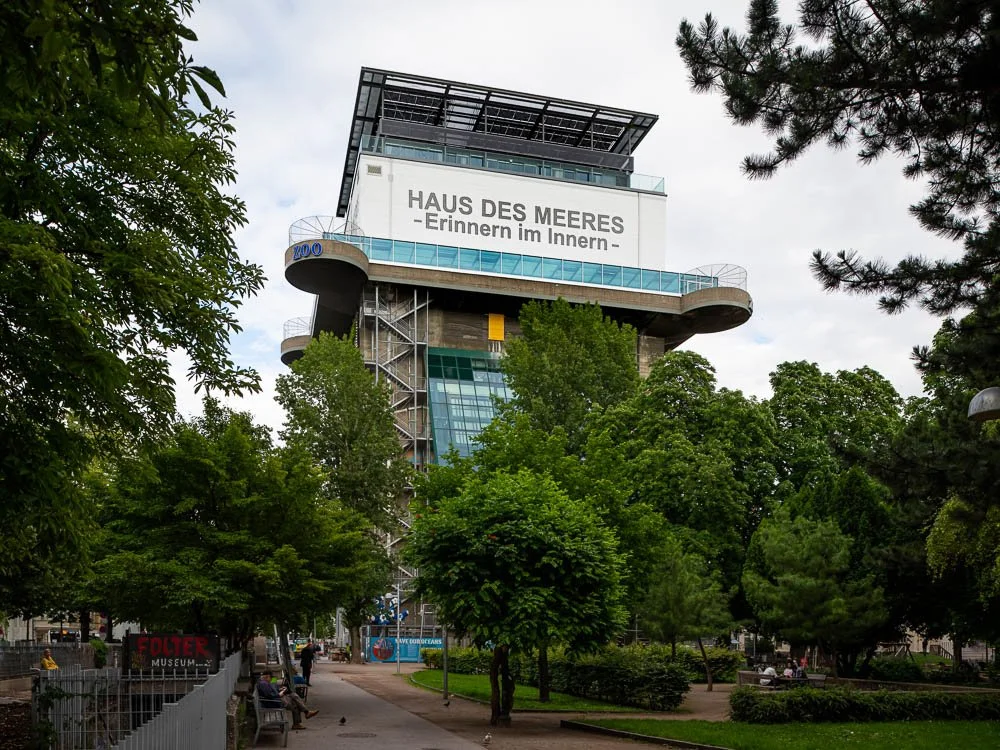
Esterhazy Park: Home to a WWII flak tower, now housing the Haus des Meeres aquarium and terrarium. The park also contains Vienna’s Torture Museum.

Apollo Theatre: Once a thriving variety theatre, later converted into a cinema that still operates today.
Final Impressions
This fotowalk through Mariahilf was full of discoveries. Until now, I mostly associated the district with shopping on Mariahilfer Straße or traffic along Wienzeile and Gumpendorfer Straße. But walking its staircases, exploring its markets, and photographing its architecture with a manual tilt‑shift lens gave me a much deeper appreciation.
Mariahilf may be small, but it’s layered with history, culture, and visual surprises — a perfect subject for both the curious walker and the architectural photographer.